

Alexandrina Council releases greenhouse gasses (or GHG for short) as a part of day-to-day operations, servicing the residents and communities of the region. From the electricity used to light our roads, buildings and community centres, to the petrol burnt by trucks transporting waste to depots, Alexandrina Council is responsible for producing GHG emissions.
Carbon emissions (CO2) are part of GHG, together with methane (CH4), nitrous oxide (N2O) and ozone (O3). GHG gases in the atmosphere absorb and re-emit heat, thereby keeping the planet's atmosphere warmer than it otherwise would be.
GHG emissions are measured as tonnes of carbon dioxide equivalence (tCO2-e). The ‘GHG Corporate Standard’ classifies a company's GHG emissions into three 'scopes'. For our corporate emissions this means:
- Scope 1 = Direct emissions from Council (i.e. transport fuels);
- Scope 2 = Indirect emissions generated by electricity consumed by Council (i.e. streetlights, council buildings); and
- Scope 3 = Indirect emissions as a result of Council’s activities, but not from sources owned or controlled by council (i.e. waste disposal, paper and water use).
To successfully reduce Council’s corporate emissions, emissions must be able accurately monitored. Alexandrina Council has been monitoring its emissions since 2015.
After street lighting, Council’s largest electricity users are the Fleurieu Regional Aquatic Centre, wastewater treatment and pumping stations, and Council’s Administration and Library buildings. As can be seen in Figure 1 & 2, a significant portion of Council’s emissions is attributed to transportation (transport fuel), followed by electricity usage.
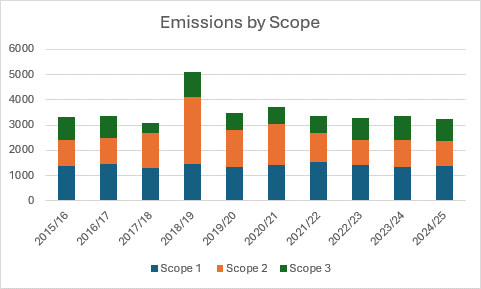
Figure 1: Council’s emissions by scope, since 2015.
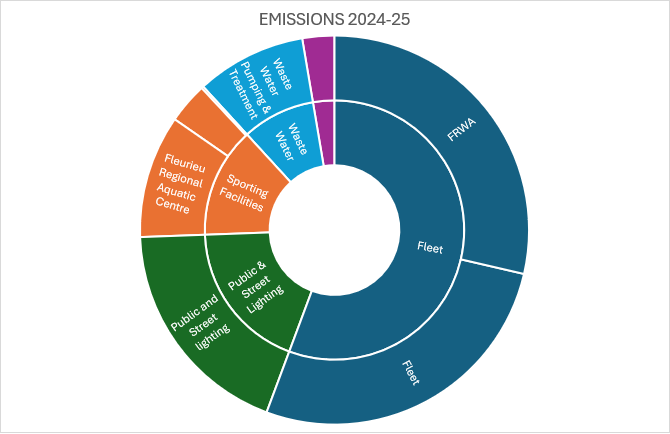
Figure 2: 2024/25 Council’s emissions by category (Other in pink = depots, community centres, parks, campgrounds, public facilities)
Council is actively investigating ways to reduce its corporate emissions, which include moving its fleet to Electric Vehicles, smart street lighting projects and solar and battery installations.
Learn more about on how Council is reducing Council’s GHG emissions here.