

Alexandrina’s township greening journey
Our trees and green spaces play a significant role in our region. They make our places and spaces more attractive and support our healthy lifestyles. As we move towards a warmer and more densely populated future, the role they play in cooling and shading our towns, sequestering carbon, and supporting regional biodiversity will be more important than ever.
Trees provide us with many benefits, as shown in Figure 1, Benefits of urban greening below.
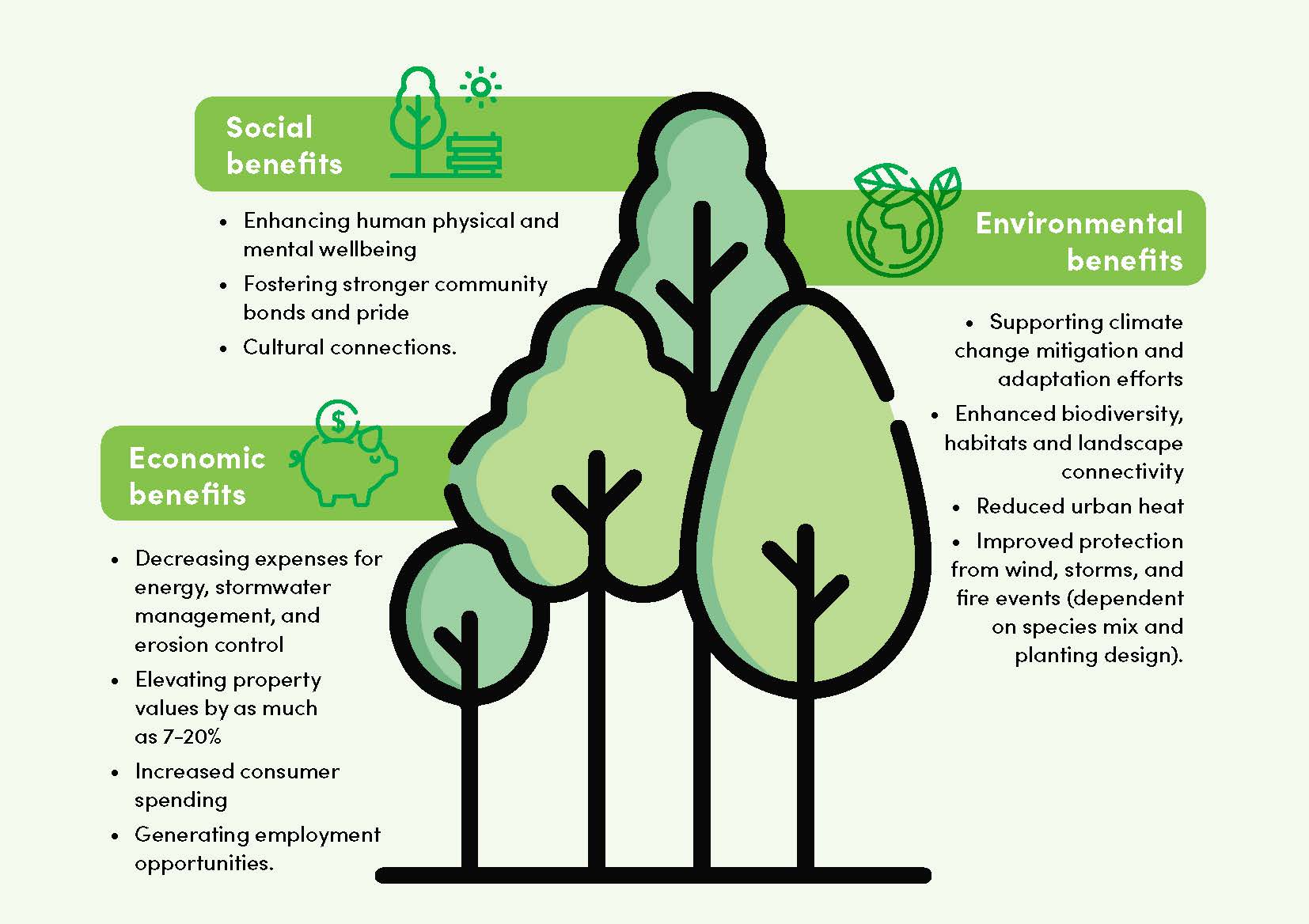
See below options to learn how Council, the community, landowners, and developers can protect what we have and increase tree and vegetation cover across our townships:
- Greening our Townships Strategy 2026-2036 Greening our Townships Strategy 2026-2036
- Greening opportunities Greening opportunities
- Alexandrina's canopy targets Alexandrina's canopy targets
- Alexandrina’s canopy targets Alexandrina’s canopy targets
Greening our townships is consistently reported to be of the highest importance to our community. This Greening our Townships Strategy is the start of our greening journey as we seek to respond to a changing climate and halt the loss of biodiversity. It sets the direction for Council, the community, landowners, and developers to protect what we have and to increase tree and vegetation cover across our townships.
Our shared vision
We will protect and grow the trees and green spaces that make our townships a ‘Liveable. Green. Connected.’ place to live in. Where our townships are vibrant, walkable communities, characterised by tree lined streets and shady, green parks and reserves that enhance liveability, promote wellbeing, and foster biodiversity.
We will work together to achieve shared goals, providing fair access to green spaces, creating greener, cooler place to live, through shard care and community pride, growing greener townships by design and prioritise thriving nature in our townships.
Through this Strategy , and as a community, we aim to achieve the following over the next decade:
Include here the overview from the one pager:
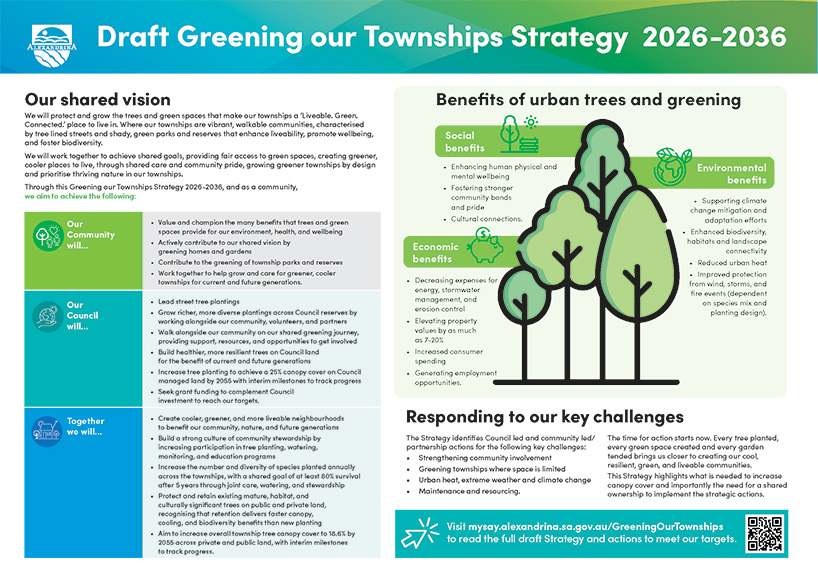
Responding to our key challenges
Increasing canopy cover and greening across our townships can only be done by working together. There are lots of challenges to achieving our target of 25% canopy cover on Council managed land and 18.6% canopy cover across all township land.
The Strategy identifies priority actions on how we, Council, community and other Government agencies, can respond to our key challenges:
- Strengthening community involvement;
- Greening townships where space is limited;
- Urban heat, extreme weather and climate change; and
- Maintenance and resourcing.
Download the one page summary of the Greening our townships Strategy.
Note that the Strategy specifically focusses on our townships – our built, urban centres because of the benefits of greening where people live work and play. Conservation, management and revegetation outside of our townships is outlined in Alexandrina’s Environmental Action Plan 2030.
Next steps
Our community is at the heart of Alexandrina’s draft Greening our Townships Strategy, which identifies greening opportunities across our townships. The draft Strategy is now open for community engagement, and we invite residents, landholders, businesses and local groups to share their ideas and local knowledge.
Your feedback will help shape a strong and practical Strategy that reflects what matters most to our communities. By sharing your priorities, opportunities and concerns, you can help Council understand where greening will make the greatest difference and which reserves, streets and township areas should be considered.
There will be several drop-in sessions from November to early December 2026, giving community members an opportunity to talk to staff, ask questions and contribute ideas. To find out how you can get involved and help grow greener, cooler and more welcoming townships, go to MySay Alexandrina website.
Greening Opportunities in Alexandrina Townships
Another central focus of the Greening our Townships Strategy is ensuring our efforts are directed to where they are needed most. Priority should be given to areas with:
- lower existing tree canopy
- social vulnerability and inequality
- greater exposure to urban heat
- increased vulnerability to climate change impacts.
Finding suitable locations that meet all of these criteria can be challenging. Many parks and reserves serve multiple functions, and planting, particularly along foreshore areas, can be constrained by competing uses and community expectations around views and open space.
The Greening our Townships Strategy identified priority parks with social value by targeting areas of high public use and exposure, lower canopy cover, as well as those with social vulnerability, such as schools. The priority locations are identified in Appendix A of the Greening our Townships Strategy. Follow the link to download the Greening our Townships Strategy document.
Next steps
Our community is at the heart of Alexandrina’s draft Greening our Townships Strategy, including Appendix A, which identifies Greening opportunities across our townships. The draft Strategy is now open for community engagement, and we invite residents, landholders, businesses and local groups to share their ideas and local knowledge.
Your feedback will help shape a stronger, more practical Strategy that reflects what matters most to our communities. By sharing your priorities, opportunities and concerns, you can help Council understand where greening will make the greatest difference and which reserves, streets and township areas should be considered first.
There will be several drop-in sessions from November to early December 2026, giving community members an opportunity to talk with Council, ask questions and contribute ideas. To find out how you can get involved and help grow greener, cooler and more welcoming townships, go to MySay Alexandrina website.
Where are we now: Alexandrina’s current tree canopy cover
Besides the obvious benefits of providing us with oxygen and shade, township greening is one of the priority items identified by our A2040 Community Vision and its A2040 Strategic Delivery Plan 2025-35. Similarly, tree canopy coverage is a key indicator for not only the health of our environment but also the community.
Hence, Council needed to understand the existing canopy cover across our townships, so we know where to plant best.
To find out more about the study or see the results per township, see below.
Alexandrina's Tree Canopy Report
In March 2023, Council adopted the Tree Canopy Benchmark Study and Thermal Imaging Report (the “Tree Canopy Report”). This Study established the current canopy cover baseline for our townships, including identifying locations where tree canopy cover is lacking. It showed that the average current urban tree canopy cover across all townships was 17.6%, which is substantially lower than the average of 23.4% across Adelaide’s metropolitan councils. However, the percentage cover between each township varied significantly, from 11.7% in Milang to 49.3% in Ashbourne.
Much of Alexandrina’s canopy cover is located on private land with 78%. In comparison, Council managed land has 21% canopy cover, and 1% of trees are found on Crown Land. From this information it can be calculated that only 1% loss of canopy of privately owned land would require a 20% increase in canopy cover on Council managed land.
This is why we all need to work together if we want to keep and increase our tree canopy cover.
You can download the full Tree Canopy Report here.
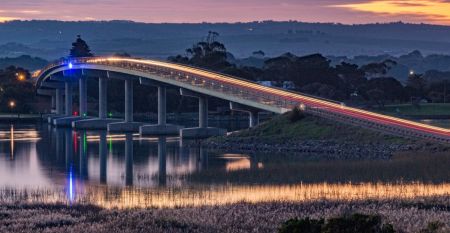
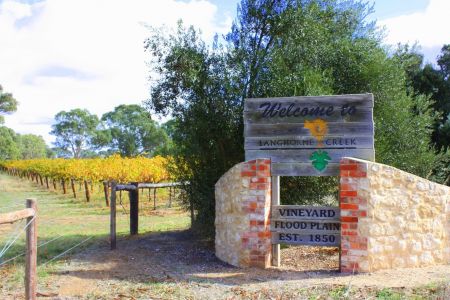
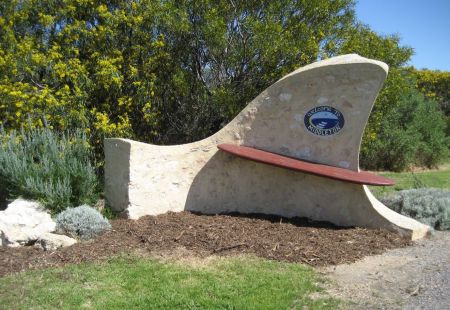
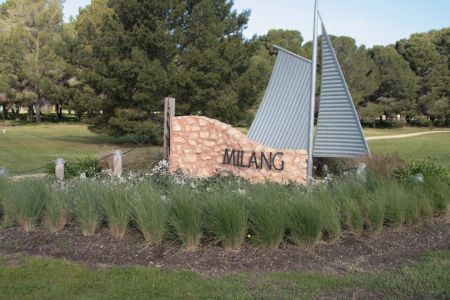
To find out the results for each township, click on the links for each township below:

The map below shows the townships that were assessed in the study.

Figure 2: Map showing the 11 townships assessed in the study (Source: Google Maps, accessed March 2023)
Where do we want to be?
To grow our tree canopy and protect local plants and wildlife, Council needs a clear plan that works across all townships and looks to the future.
Council commissioned the Setting Canopy Targets, Greenprint for Success study to help set tree canopy targets for each township. The study recognises that every township is different, with its own land uses, layout and current level of tree cover.
The study looked at five possible options. Each option (scenario) shows a different way Council could increase tree canopy while also improving access to trees and green spaces across the community.
Scenario 1 was recommended in the study as the minimum target for each township and for Alexandrina as a whole. This option would double Council’s current tree planting program to about 600 trees each year until 2055.
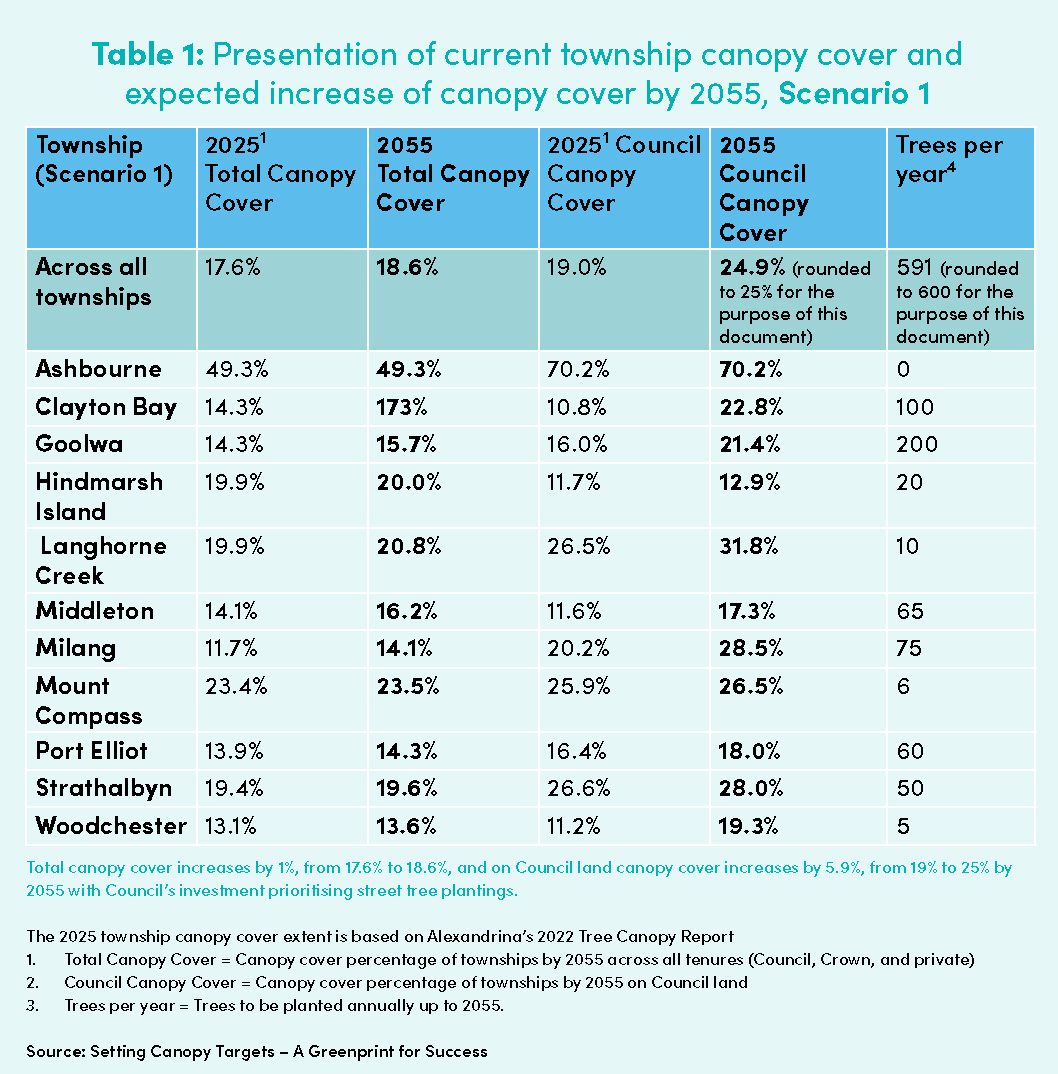
Scenario 1 outlined in Table 1 gives the smallest increase in tree canopy compared with the other scenarios in Table 2. However, it is the most realistic option within Council’s current Annual Community Plan (budget).
More trees could be planted if there is more planting on private land, if planting starts sooner, or if more funding becomes available. These options would need more money upfront, so Council will look for external funding to help increase tree canopy more quickly.
Reaching canopy targets sooner
Planting trees sooner is better for our communities and better value over time. As trees grow, they provide more shade, cooler streets and better habitat for local plants and wildlife. The earlier we start, the sooner the community can enjoy the benefits of mature trees.
The Greenprint for Success study found that planting more trees in the early years would cost more at the start. However, it would help Alexandrina reach its canopy targets sooner, reduce costs over the long term and deliver environmental benefits earlier.

Table 2 compares the outcomes and costs for each scenario. Scenarios 3 to 5 involve planting more trees earlier over a shorter timeframe. This would cost more at the start, but it would help Council reach canopy targets faster, provide benefits sooner and save money over time. For example, Scenario 5 reaches a 30% canopy target on Council land faster and more cost effectively than Scenario 1 or the steady planting approach in