
1 in 3 Australians experience a disaster or the threat of one.
Community-Led Disaster Resilience Project summary
Alexandrina Council worked with the Australian Red Cross and Mount Barker District Council to deliver Community-Led Disaster Resilience workshops in Ashbourne and Woodchester. Local knowledge and strengths, neighbourhood connections and emergency planning have proven to help communities respond better and recover faster in a disaster.
What was involved?
Participating townships received five initial workshops facilitated by the Red Cross, aimed at enhancing local disaster resilience through community co-creation. Through the workshops we worked with residents and community members to:
- Identify local multi-hazard risks (fire, flood, earthquake etc), assess resilience, make a comprehensive disaster resilience action plan together.
- Connect community members, emergency services, and local council to share responsibility for disaster preparedness, response, and recovery.
- Identify community resources and strengths.
- Plan and action a whole of community approach to disaster resilience with a focus on inclusivity, equity, and sustainability.
Ongoing support
Participating townships are implementing their actions with support from Red Cross and/or Alexandrina Council and are encouraged to join the Community-led Disaster Resilience Network to exchange ideas and resources with other communities across SA.
 This project received grant funding from the Australian Government.
Mount Barker District Council was the grant holder and partnered with Alexandrina Council to deliver the project in our region.
Ashbourne
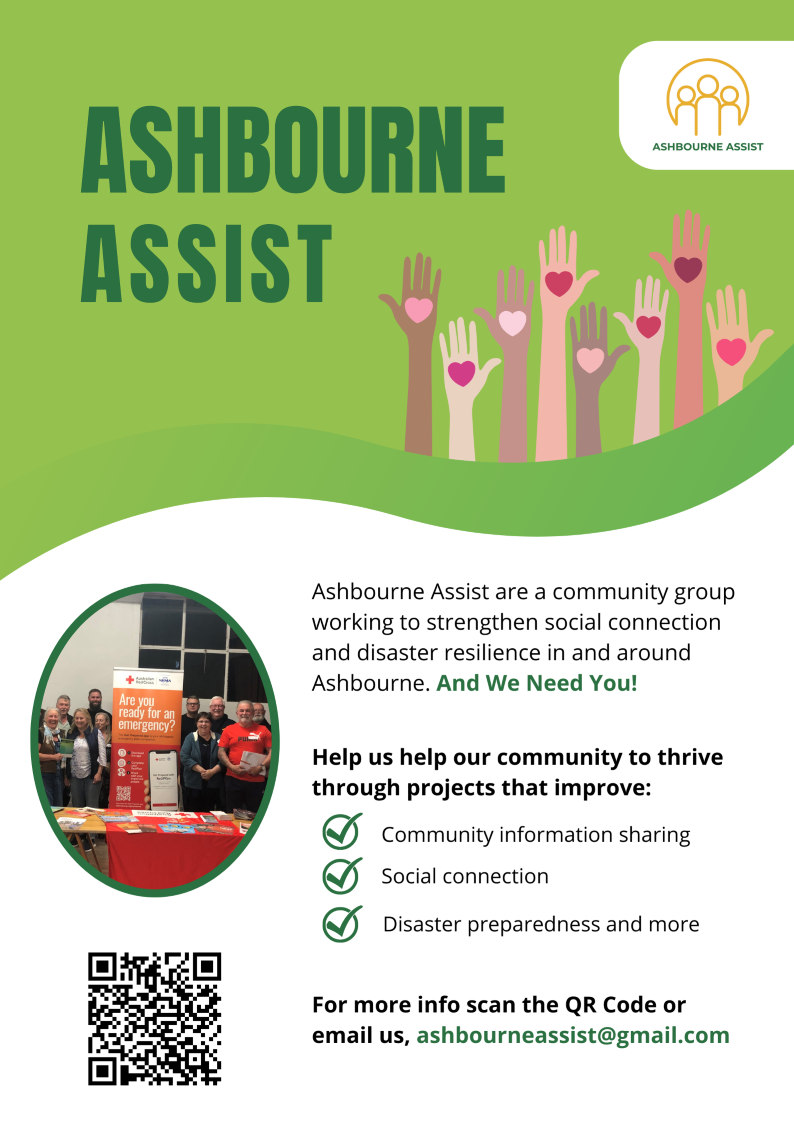
Through a series of five workshops the Ashbourne community identified its strengths, risks and opportunities to build disaster resilience and community connection. They have developed a Community-Led Disaster Resilience Action Plan. This plan includes actions to improve:
- Community information sharing
- Social connection
- Disaster preparedness and more
The community have formed a group called Ashbourne Assist who are working towards implementing their action plan.
Outcomes so far include strengthened community connections and wellbeing through community events, improved knowledge of disaster preparedness through training sessions with CFS and Red Cross, and speed limit reduced from 60kmph to 50kmph along Bull Creek Road in Ashbourne.
For more info and to connect with the group, email ashbourneassist@gmail.com.
This project received grant funding from the Australian Government.
Mount Barker District Council was the grant holder and partnered with Alexandrina Council to deliver the project in our region.
Woodchester
If you would like to know how to connect with the community members working on the plan, please contact the Community Development Team on 8555 7000 or email alex@alexandrina.sa.gov.au.
This project received grant funding from the Australian Government.
Mount Barker District Council was the grant holder and partnered with Alexandrina Council to deliver the project in our region.
Mount Compass
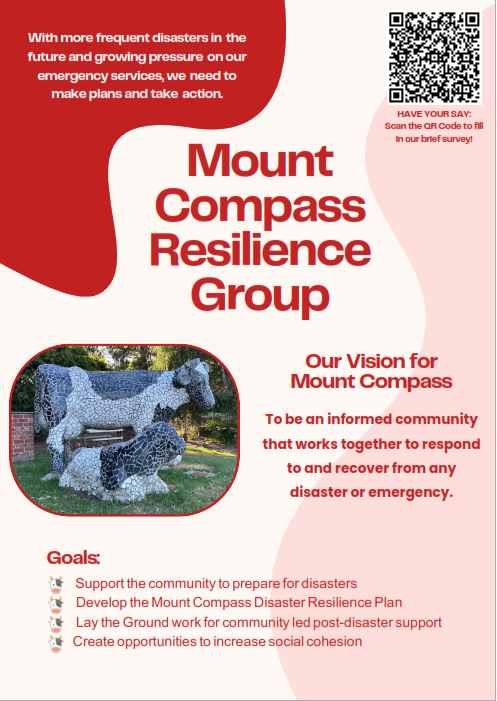
The Mount Compass community have concluded the workshops with Red Cross continuing to support the Mount Compass community as they work towards implementing their Community-Led Disaster Resilience Action Plan. The community prioritised their actions when developing the plan. The plan includes actions to:
- Strengthen social connection, with a focus area of children and young people
- Develop a 72-hour plan to be able to offer support to the community directly after an emergency
- Upgrade community infrastructure and safety including creating an asset checklist
- Increase knowledge, communication and upskilling community for disaster preparedness
Red Cross lead this project with support from Alexandrina Council Community Development staff. With the support of a Red Cross facilitator a recent Redi - Plan workshop had 26 participants developing their personal preparedness plans. Another workshop is being planned for the near future.
If you would like to know how to connect with the community members working on the plan, please contact Mark Wilson mtcompassresiliencegroup.mcwmcc@gmail.com
Mount Compass Resilience Group
This project received grant funding from the Australian Government.
Alexandrina Council partnered with Australian Red Cross to support the delivery of this project. Australian Red Cross was the grant holder.
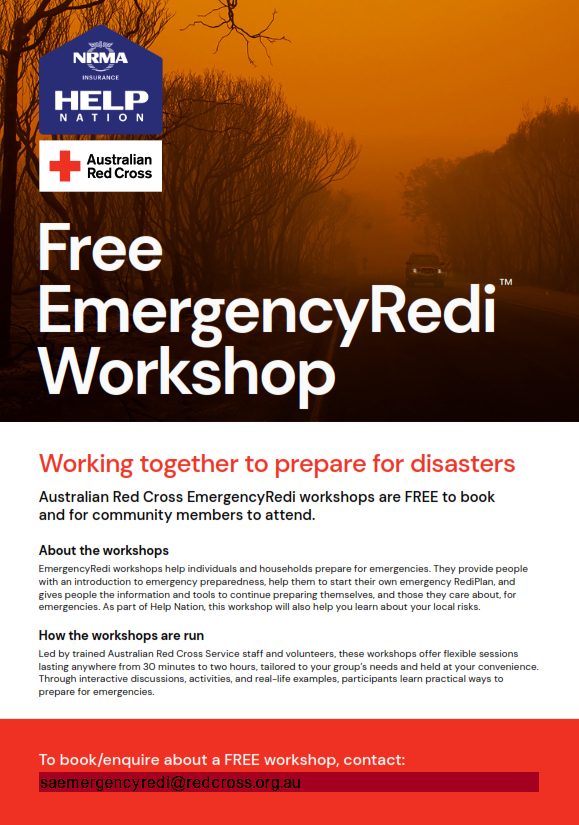
Do you have a group or organisation who might be interested in hosting an EmergencyRedi Workshop? These workshops are currently available free to community groups.
EmergencyRedi workshops support people to learn about preparing for emergencies and take steps towards building their individual and household resilience.
EmergencyRedi workshops are flexible and can be adapted to local contexts and tailored to suit different audiences. Participants learn about the practical, psychological and social steps they can take to prepare for emergencies and minimise the impacts of disaster and other crises on their lives.
EmergencyRedi workshops are:
- flexible and can be run anywhere from thirty minutes to two hours, depending on the requirements of the group
- tailored to the needs and context of the group
- held at a time and place convenient for the group
- relaxed and informal
- interactive and include real examples and anecdotes, facilitated discussions and activities
- focused on practical ways you can prepare for emergencies
For further information please visit EmergencyRedi workshops | Australian Red Cross
The people at risk in emergencies framework for South Australia has been developed to support the wellbeing, knowledge, connection and security of people who are most at risk in emergencies and
- adopts a whole of community approach.
- builds on strengths.
- tailor approaches to individual capabilities.
- lead action together.
The framework is written to provide some guidance for emergency management organisations and the health and community services that support people that may be at increased risk in emergencies on how to work together effectively.
South Australian Council of Social Services (SACOSS) and Red Cross are keen to make sure this document is respectful in how it refers to people at increased risk.
Personal Emergency Preparedness - Make a Plan
Emergencies may not be something we think about every day but they can happen. Knowing what to do and being ready is your best protection. With a simple plan, be prepared and cope better if an emergency occurs.
The Australian Red Cross have developed the Emergency REDiPlan to assist people to plan for any emergency:
Red Cross RediPlan
Red Cross RediPlan - Easy English
A range of other REDiPlan resources are also available. See the Australian Red Cross website to download booklets, plans, children’s activity books and more in various formats.
Useful resources
- Alexandrina Council's Bushfires and Extreme Weather webpage: This page includes links to information about household bushfire and emergency preparedness, fire danger ratings, Bushfire Safer Places and more.
- Bushfire Resilience Rating Home Self-Assessment App: Use the app to measure how well your home would perform in a bushfire event and understand what you can do to make your home safer.
- Bushfire Resilience website: Get your household bushfire resilient with a range of free webinars and bite-sized topics.
- Community-Led Resilience Teams guide: This resource by the Red Cross will guide you through seven easy steps to establishing and developing a community-led resilience team to take action on disaster resilience in your local community.
- Community Support Hub Guide: Community Support Hubs enable communities to gather locally to obtain social support, seek information and have their basic needs met before, during or after an emergency. The Community Support Hub Guide explains how communities can establish and operate a Community Support Hub, including case studies from South Australia.
- Preparing Your Community for Disasters and Emergencies handbook: A South Australian handbook that explains the community disaster planning, preparation, response and recovery process and how to build community resilience, drawing on local case studies.